
If good candidates ignore your vacancies, or accept and then leave within a year, the cause usually sits in something they learned about you before applying, or in their first months. Employer branding for a healthcare clinic is how the people you want to hire see you as a place to work, and every medical practice has one whether or not anyone manages it.
It rests on four things: an offer that is acceptable and visible, specifics about support, proof that matches across sources, and an easy hiring process. The 30-minute Candidate Check below shows which one is failing first.
This guide also covers an EVP template, a content check against AHPRA’s advertising rules and a simple vacancy-cost model. It does not find candidates for you, give legal advice or set pay benchmarks.
What candidates do before they apply, and why that is your employer brand
What is the difference between an employer brand and an EVP?
Four ideas get mixed up.
| Term | What it is | Who controls it |
|---|---|---|
| Employer brand | What people outside the clinic believe about it as a workplace | Nobody directly. It is the sum of what candidates find |
| Employee value proposition (EVP) | What you offer and what you expect in return | You write it |
| Employee experience | What working there is actually like | Decides whether the other two are true |
| Recruitment marketing | Advertising a specific vacancy | You, per vacancy |
The EVP is where you set the offer and the fit. The employer brand is what candidates conclude about whether to trust it. The experience decides whether it is true. Some practices describe the goal as becoming an “employer of choice”, which is the same idea: being the clinic a good candidate picks when they have options.
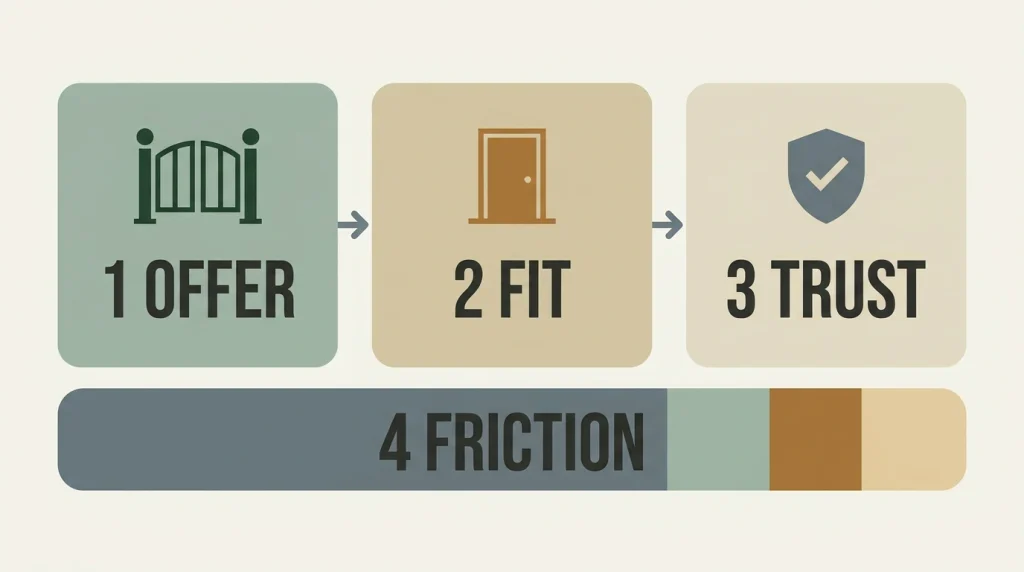
A candidate weighing you up runs four checks, usually without realising it, and you can lose them at any one. This guide calls them the four layers.
| Layer | The question the candidate is asking | How clinics typically fail |
|---|---|---|
| 1. Offer | Are the terms acceptable and will this fit my life? | Terms hidden, vague or revealed only at interview |
| 2. Fit | Will the work itself be good? | Claims with no specifics (“supportive team”) |
| 3. Trust | Do I believe what you say? | Sources contradict each other, or there is nothing to check |
| 4. Friction | Is it easy and respectful to deal with you? | Slow replies, long forms, vague process |
Layer 1 behaves mostly like a gate. Layers 2 and 3 tend to decide between offers that pass it. Layer 4 can lose a candidate at any point. That ordering is interpretation, drawn from the evidence below.
Why does employer branding matter for a clinic?
Candidates check before they act. In an Indeed survey of 14,654 job seekers in 2023, nine in ten said they research a company before applying. Almost every clinician is also already employed: occupation-level unemployment rates reported by Indeed AU in October 2025 were about 0.55% for GPs, 1.47% for registered nurses and 0.93% for physiotherapists.
Clinicians also rarely move. In a 2021 Healthed survey of about 850 GPs, reported by Medical Republic, 70% had not changed practice in five years. In AusDoc.JOBS’ Job Seeker Study of 707 GPs, about half had held their current job for five years or more.
One reading of those numbers is that you compete less with the clinic down the road than with the candidate’s current job. Most people move only when the risk of moving looks smaller than the risk of staying, and employer brand work shrinks that perceived risk.
In a clinic of ten, each person is a large share of what candidates, referrers and reviewers see, which ties hiring and retention directly to the brand.
The research here covers what candidates weigh and how they behave. It does not measure the return on branding spend, and the evidence is strongest for GPs and weakest for dental, psychology and allied health.
Claims such as “50% more qualified applicants” or “28% lower turnover” recur on vendor sites without a primary source that could be verified, so none are used.
What is different in 2026?
Much of the Australian evidence on this topic dates from 2021 to 2025, and much of it concerns GPs. No 2026 clinic-level dataset turned up while preparing this guide, so check three things against current sources before acting: how AI assistants describe your clinic (the Candidate Check covers this), any funding or incentive change that affects your pay model, and current registration and sponsorship rules for overseas-trained clinicians, which AHPRA and the Department of Home Affairs publish.
Run the 30-minute Candidate Check
Short answer: Search for your clinic the way a candidate would, score what you find on four tests, and write down every place where two sources disagree.
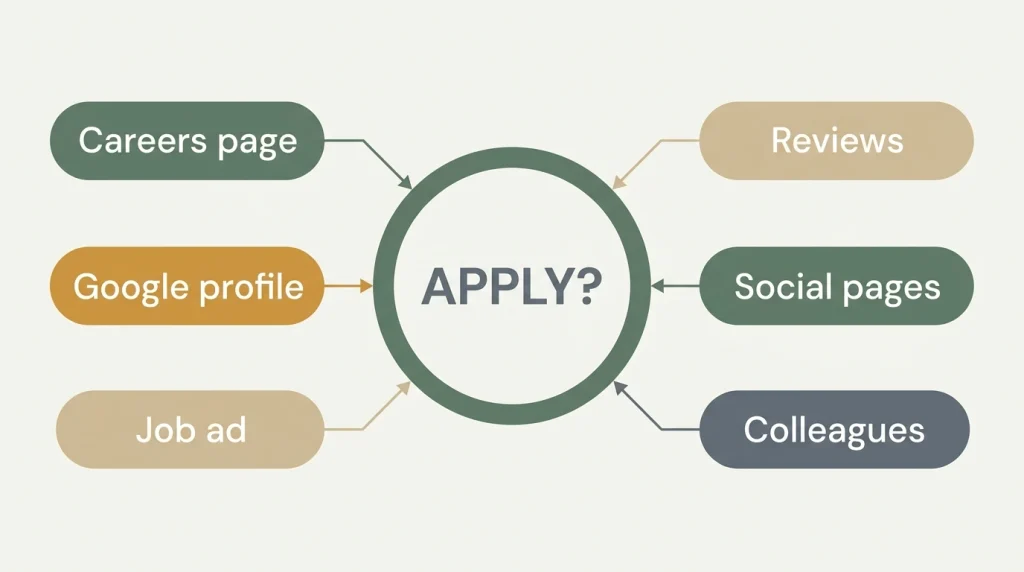
Step 1. Choose your candidates. Pick the roles you are hiring for or most afraid of losing. If you can, run all six: VR GP, new graduate (any profession), overseas-trained clinician, practice nurse, reception, practice manager. Ideally have someone outside the clinic run it, or run it yourself on a phone.
Step 2. Check each touchpoint.
- Search your clinic name, then your name plus “jobs”, “reviews” and “working at”.
- Open your Google Business Profile. Look at photos, hours, and whether it links to a careers page.
- Find your careers page from your homepage, on a phone. Count the taps.
- Read your live job ad on every board where it appears: SEEK, Indeed and any healthcare-specific boards you use, such as recruitGP, AusDoc.JOBS or HealthcareLink. Check whether your vacancies appear in Google’s job results (Google for Jobs).
- Look for employer reviews on SEEK, Indeed and Glassdoor. Read your Google reviews as a candidate, not an owner.
- Check your LinkedIn page, Facebook, Instagram and any staff profiles that name the clinic.
- Ask an AI assistant: “What is it like to work at [clinic] in [suburb]?” Note what it says and which sources it seems to draw on. Treat this as a snapshot, not something you can control directly. If AI answers matter to you, Pracxcel’s page on AI search visibility for healthcare practices explains the approach.
- Run a reverse reference check. Ask two or three clinicians who do not work for you, or a recruiter who places in your area, what they have heard about the clinic. Word of mouth is hard to see and can carry a lot of weight.
Step 3. Score each touchpoint 0, 1 or 2 on four tests. Copy the table into a spreadsheet, one row per touchpoint per candidate.
| Test | 0 | 1 | 2 |
|---|---|---|---|
| Present | Nothing there | Exists but thin or outdated | Complete and current |
| Accurate | Wrong in places | Mostly right | Matches reality today |
| Consistent | Contradicts another source | Minor differences | Identical facts everywhere |
| Specific | Slogans only | Some concrete detail | Numbers, names, structures |
Step 4. Read the results. Do not add it into one score. List every 0, then list every place where facts differ between sources: team size, hours, billing model, flexibility, what you say about training. Contradictions are the easiest problem to miss and among the costliest. A candidate who finds two versions of your hours or billing model has reason to wonder what else is loose.
Find which layer is costing you hires
Short answer: Match what you see in your hiring, or in your Candidate Check, to the table below, and fix that layer first.
| What you see | Likely layer | First thing to do |
|---|---|---|
| Few or no applications | Trust or findability | Check your jobs can be found from your name and from search, and that your sources agree |
| Applications, but poor fit | Fit | Rewrite the ad with specifics: structure, support, what a normal week looks like |
| Good candidates go quiet before interview | Friction | Shorten the apply path, reply faster, name a contact |
| Candidates decline at offer stage | Offer | Compare your terms with live local ads, review guarantees and flexibility |
| Hires leave within a year | Gap between promise and reality | Compare each claim in your ad with what staff say, and fix onboarding |
| Only referrals work | Trust travels through people | Make referrals and a talent list formal |
| Check shows different facts in different places | Trust | Write one fact sheet and correct every source |
| Check shows no billing model or pay structure | Offer | Use the Layer 1 checklist |
| Check shows generic wording everywhere | Fit | Interview staff and build the one-page EVP |
| Check shows nothing for nurses or reception | Fit | Add role-specific proof |
| Check shows patient testimonials on recruitment pages | Trust and compliance | Remove them and check against AHPRA guidance |
| Check shows thin or unclaimed employer reviews | Trust | Claim the profiles and decide how you will respond |
| Good information, few visitors | Findability | Check job-search visibility before paying for reach |
This table is an analytical model built from the evidence. It has not been tested on a sample of clinics, so use it to order your thinking.
Three cases need extra care:
- A new clinic with no tenure or reviews. Do not fake social proof. Lead with named clinical leadership, clear terms, and a paid trial session or locum-to-permanent option.
- A clinic with a poor reputation. Find the cause first. A better careers page over a known problem makes things worse.
- An owner who cannot change the terms. Then your job is accurate positioning. Pick the true things you can compete on and say them clearly.
A clinic that hires two or three people a year cannot learn much from one withdrawal, so look for patterns over several vacancies before changing course.
Running several sites? Decide centrally the offer structure, pay philosophy, compliance rules and how you respond to employer reviews. Let each site own its team stories, suburb detail and rosters, and say so by site if support differs. For the marketing side, see centralised versus decentralised marketing for healthcare groups.
Layer 1: Get the offer right before you tell the story
Short answer: Pay structure is one of the first things candidates check, and the surveys suggest location, flexibility and working environment weigh at least as much when candidates choose between acceptable offers. None of the surveys can show which comes first, so treat the order as a working interpretation.
Why the surveys seem to disagree
| Source and sample | Question | Finding |
|---|---|---|
| Healthed survey, about 850 GPs, 2021 (mostly capital cities, mostly over 50, 6+ years at current practice) | What caused you to leave your previous practice? | Location or travel time 25%, family 24%, culture or atmosphere 18%, starting own practice 15%, insufficient reimbursement 7% |
| Same survey | What attracted you to your current practice? | Location 32%, flexibility 30%, positive culture about 20% |
| AusDoc.JOBS survey, 500+ GPs | Why do GPs change jobs? | Over 35% changed for higher pay. Only 10% were completely satisfied with their pay |
| AusDoc.JOBS Job Seeker Study, 707 GPs | What was a deciding factor in accepting a role? | Flexibility 56% (64% of women, 47% of men), location 55%, learning new skills 45% |
| Same study | What are you looking for, or seeking a new role for? | Paid training 47%, extra paid leave 38%, salary increase 35%, partnership 27% |
| AusDoc.JOBS job-ad checklist, citing its annual study | What do you weigh when reading an ad? | 72% treat salary or billing percentage as a top criterion |
These are not contradictory. They ask different questions of different people. The Healthed sample is older, mostly city-based and long-tenured, so more likely to be settled. The AusDoc samples are broader, and the years of the two AusDoc studies were not shown in the extracts read for this guide.
The 72% figure shows pay structure is among the first things candidates look for in an ad. It cannot show whether it settles the decision or only gets you shortlisted.
A recruiter quoted in the Medical Republic piece also noted that GPs often do not name a poor practice culture as a reason for leaving, perhaps because of confidentiality or fear of looking difficult. If so, surveys will tend to understate culture. That is one recruiter’s observation, so weigh it accordingly.
Taken together, money has to be acceptable, and location, flexibility and working environment then do much of the deciding. All of this evidence is about GPs. For nurses, dentists and allied health the same logic is plausible but untested here.
Should a job ad show pay?
Yes: show the structure and a range. Leaving it out forces candidates to ask or guess. Stating a billing model is the minimum. What sets an ad apart is what sits beyond it: the guarantee period, the patient list, the support ratio, appointment length and the clinical software.
What to state in the ad
- Billing model: bulk billing, mixed or private. A percentage means little without it.
- How the clinician is paid: percentage of billings, base plus percentage, hourly, or a guaranteed minimum and for how long (see the employment-model note below).
- A range, not “competitive”.
- Patient list: an established book to take over, or one the new clinician builds.
- Sessions and hours, including any on-call or weekend expectation.
- Getting there: how long it takes, and where people park or catch transport.
A high percentage of a thin patient list can pay less than a modest percentage of a full one, so say which you are offering. The same principle applies to associate dentists and allied health: state the pay structure and what the first months look like. Team size, clinical software, supervision and how to apply belong on your fact sheet in Layer 3.
Flexibility is part of the offer, and it has a cost
Flexibility was a deciding factor for 56% of GPs in the AusDoc.JOBS study, and more often for women than men. A recruiter quoted by Medical Republic said clinics offering job share or part-time arrangements are likely to do better.
Options include part-time sessions, job share, compressed days, school-hour rosters and “no after-hours” arrangements. Each has a cost: empty rooms, less continuity for patients, a heavier load on whoever covers.
Decide what you can sustain, and advertise only what exists. AusDoc’s survey also found some GPs would rather earn more for weekends and after-hours than avoid them, so offering choices works better than one fixed pattern.
If your location is the problem
In the Healthed and AusDoc 707-GP surveys, location ranked first or second, and it is mostly measured as travel time from home. You cannot move the clinic, but you can say plainly how long it takes to get there and where people park or catch transport.
For regional and rural roles, candidates weigh housing, schools, partner employment and isolation, so cover those and say what relocation help exists. A paid trial period or locum-to-permanent arrangement lets someone test the lifestyle before committing.
If you cannot fix the commute, a compressed week with fewer attendance days may offset it. That is a judgement, not a finding.
For overseas-trained candidates, location and lifestyle can work in your favour. Indeed AU cites a 2025 study of international medical graduates in which better working conditions (19.3%), family opportunities (14.5%) and lifestyle (14%) were the top reasons for choosing Australia, and location and lifestyle (31.4%) was what they most enjoyed once here. Confirm against the underlying study before relying on it.
If you cannot match corporate terms
Compete on what is true and hard for large groups to copy: autonomy, continuity of patients, mentoring and access to the principal. In one AusDoc survey, 22% of GPs in corporate-owned practices felt underappreciated, against 15% in non-corporate practices, so recognition may be a genuine strength for a small clinic. That is one survey.
If the percentage is fixed, other levers are cheaper. In AusDoc’s 500+ GP survey, the ability to take unpaid leave would attract 48% of women and 37% of men, and paid training mattered to 41% of women against 27% of men, and to 50% of rural GPs against 31% in capital cities.
If the offer fails the gate, no story fixes it. Change the structure, for example by adding a guaranteed period, before spending on marketing.
Your employment model is part of the offer
Whether you engage clinicians as contractors or employees affects tax, superannuation and legal risk. The rules, including state payroll tax treatment, differ and keep changing, so get advice from an accountant or employment lawyer before you advertise a model, and do not copy someone else’s.
A guaranteed minimum can affect how an arrangement is classified, so ask before advertising one. For support staff, pay is often set by a modern award or enterprise agreement, and an ad must not undercut it. The Fair Work Ombudsman publishes guidance on contractors, employees and award coverage.
Layer 2: Write an EVP your staff would recognise
Short answer: Write one page covering who you hire, what they get, what you expect, and the proof for each claim, then have your own staff test it.
In its competitor analysis for Healthscope, an agency (Truly Deeply) reported that most healthcare providers’ employer messaging was generic and hard to tell apart. Phrases like “friendly team” and “work-life balance” are interchangeable between clinics, so they persuade no one.
The one-page EVP
| Section | What goes in it |
|---|---|
| Who we hire | The roles, experience level and the kind of clinician who does well here |
| What you get | Terms, support, development, flexibility, tools |
| What we expect | Hours, systems, team behaviour, patient mix |
| Proof | For every claim above, the evidence you can show |
How to build it
- Ask three to five current staff and, if possible, one recent leaver: why did you join, what nearly stopped you, what would you tell a friend?
- Draft the page from their answers, not from your own sense of the clinic.
- Run the recognition test: show the draft to staff. Any line they would not repeat to a friend gets fixed or cut.
What specific looks like
This is an illustration, not a real clinic. Square brackets mark where your own facts go.
Generic ad: “Join our friendly, growing practice. Great earning potential and a supportive team. Apply now.”
Specific ad: “VR GP, three or four days a week, mixed billing. [X]% of billings [with a guaranteed minimum for the first [X] months, only if your employment model allows it]. Established patient list to take over. Two nurses run the treatment room and recalls. Twenty-minute appointments. Six months of mentoring from a senior GP with one protected hour a week. [X] minutes from [station], parking on site. [Software].”
The second version can be checked, argued with and trusted. It will also put off some candidates, and that is a benefit.
One EVP, several audiences
Keep one set of facts, and change the proof you lead with for each role. An Australian study of rural GP recruitment (Hemphill and Kulik, 2009) built a taxonomy of family, job and practice attributes and argued that practices should differentiate their recruitment messages to match. The data are old, but the principle holds. For profession-specific detail, see Pracxcel’s guides to digital marketing to attract GPs, recruiting dentists and attracting physiotherapists.
| Candidate | What they are uncertain about | Proof that answers it |
|---|---|---|
| GP registrar | Supervision and teaching time | Accreditation, how many registrars you take, supervisor capacity |
| New graduate | Mentoring, caseload | A structured first year, named mentor, caseload ramp |
| Experienced clinician | Autonomy, patient list, billing | Terms, patient book, support ratio |
| Associate dentist | Pay structure, patient flow, equipment | Pay model for the first months, named mentor, equipment and support detail |
| Physio or allied health | Caseload, referral flow, mentoring | A typical week, caseload cap, mentoring structure |
| Overseas-trained clinician | Registration, sponsorship, settling in | A written supervision and onboarding plan, links to official sources |
| Practice nurse | Scope, leadership, isolation | Nurse leader, scope of practice, mentoring |
| Reception and admin | Rosters, progression | Stable rosters, development path |
| Practice manager | Authority, owner support | Defined remit and reporting line |
The dentist and allied-health rows are reasoned from general recruiting logic, not from survey data.
Support staff behave differently from clinicians. Most of the Australian material found on this topic is written for doctors. In a survey of 786 general practice nurses (Halcomb and Bird), 86% intended to stay in nursing and 77% in general practice, but 16% were undecided.
Another study in one Primary Health Network found 44.9% unsure whether they would stay in general practice. It linked higher satisfaction to having an identified nurse leader, using their qualifications fully, and not feeling isolated or lacking mentoring, with pay scoring lowest.
These are nurse-only studies, so they should not be stretched to reception or practice managers. But the pattern suggests what to prove to nurses: who leads them, what they are allowed to do, and who they can learn from.
Inclusion and parental leave. In AusDoc’s 2021 study, 62% of job seekers said they value an inclusive work environment. An analysis of a national longitudinal survey of Australian doctors found that women GPs were more likely than men to leave unexpectedly, especially those under 40 with young children, even though they reported below-average intentions to leave.
That points, as a reading and not a finding, to proof about parental leave, return-to-work sessions and predictable rostering, not just a diversity statement.
Overseas-trained candidates. Have your sponsorship and supervision plan written before you market to them. In a Wavelength poll of clinics (self-rated, with sample size and date not shown, so indicative only), respondents rated their understanding of sponsorship obligations at 3.1 out of 10 on average. Never promise visa outcomes, and link to the regulator’s pages instead.
Layer 3: Prove it
For every claim, publish something a candidate can check, and keep your facts identical everywhere.
Claim to proof
| Claim (weak wording) | Stronger proof | Check before publishing |
|---|---|---|
| “Supportive team” (mentoring) | Named mentor, weekly protected hours | Staff story about work and development, not clinical outcomes |
| “Work-life balance” | The actual roster pattern and session options | Only promise what exists |
| “Great nurses” | Nurse-to-clinician ratio, admin cover | None |
| “Low turnover” | Median staff tenure | Only if you have measured it |
| “Room to grow” | Named progression stories | Consent |
Keep one fact sheet
Make a single document listing the facts candidates compare: address, hours, team size and roles, billing model, clinical software, supervision arrangements, how to apply. Copy from it into your website, job ads, Google profile and social pages, and update it when anything changes.
The 60-second test
A candidate on a phone should be able to answer five questions in a minute:
- What is the role and how is it paid?
- Where is it and how long does it take to get there?
- Who would I work with and who supports me?
- What software and equipment will I use?
- How do I apply, and when will I hear back?
Add JobPosting structured data (a small piece of code that tells Google your page is a job vacancy) to each vacancy page so it can appear in Google’s job results (Google for Jobs), and remove expired roles promptly. Check Google’s current requirements. A conversion-optimised healthcare website keeps this easy to use on a phone, and healthcare SEO for job and location pages helps those pages get found.
Patient reviews and employer reviews are different
Patient reviews tell a candidate the clinic is busy and cared about. They are not employer proof, and they should stay off recruitment pages (see below). Employer reviews live on SEEK, Indeed and Glassdoor, and these pages can exist whether or not you set them up. Healthcare job boards such as HealthcareLink have also let employers create a practice profile with testimonials from staff about working there.
Claim and complete the profiles you can, answer reviews courteously, never write them yourself and never pressure staff to post. For the staff stories and updates candidates see, organic social and Google Business Profile support can keep the content moving.
Clinics in the same Wavelength poll rated their website messaging for prospective GPs at 5.2 out of 10 and their marketing material for clinic strengths at 4.9. Read that as a prompt to check your own site, not as a market benchmark.
What you can and cannot publish
This is general information, not legal advice. Check current guidance before publishing.
| Content | Risk | How to handle it |
|---|---|---|
| Staff stories about mentoring, rosters, development | Lower | Avoid claims about patient outcomes |
| Patient reviews or testimonials near recruitment content | Higher | Keep them off recruitment pages |
| Pay claims (“earn $X”) | Misleading-conduct risk | State the basis, conditions and guarantee period |
| Filming or photographing in clinic | Privacy | Written consent, check screens and whiteboards, or leave patients out |
| Candidate outreach by email | Spam and privacy rules | Consent, unsubscribe, secure storage |
AHPRA’s advertising rules apply to anyone, registered or not, who advertises a regulated health service, and they bar testimonials about the service or business. AHPRA says it cannot pre-approve advertising or give opinions on it, and it looks at the overall impression.
A job ad aimed at staff is arguably not advertising a health service to patients. A careers page on a patient-facing website can sit inside the same frame, so keep clinical claims and patient testimonials off recruitment pages. The current guidelines took effect in December 2020, so check AHPRA’s advertising guidance and FAQ for a newer version.
Job ads must also not discriminate. The Australian Human Rights Commission and business.gov.au have guidance, and it is worth checking before you use wording that targets a gender, age or background. Pracxcel’s AHPRA advertising checklist covers the patient-facing side, and its guide to using social media to attract clinicians covers recruitment posts.
Layer 4: Remove friction: the candidate experience
How you treat applicants is the first sample of how you run the clinic. One recruiter told Medical Republic that the first thing GPs mention in interview feedback is whether the person they met was friendly and engaging. That is one recruiter’s view, but it matches common sense.
- Reply to every applicant within one working day, even if only to acknowledge. Treat that as a sensible standard, not a proven threshold.
- Ask for name, phone, email and CV. Collect the rest on a call.
- Give one named contact, and keep interviews to two steps where you can.
- Let the candidate visit and meet the people they would work with. If a trial involves real work, pay for it: unpaid trial shifts can be unlawful in Australia, so check the Fair Work Ombudsman’s guidance first.
- Put the offer in writing: pay, hours, support, start date.
- Decide quickly and tell unsuccessful applicants.
Retention is employer brand
A candidate accepts because of what the ad promised, the reality differs, they leave and mention it to colleagues, and you re-advertise the same promise to the next candidate, who checks you and finds the traces. That loop is a model, not a measured pattern, and it is why retention belongs in an employer brand plan.
Compare the ad with reality each quarter
Give your current ad to staff and ask them to mark each claim true, partly true or not true. Fix the claim or the practice.
Run stay interviews
Hold one short conversation a year with each person you would hate to lose. Ask:
- What keeps you here?
- What would make you leave?
- What is one thing we should change?
- What has surprised you?
- Who would you recommend us to?
Have the practice manager or an outside person ask if staff may not answer the owner honestly. One Australian HR practitioner quoted by HCAMag recommends external interviewers. Act on one or two things, and do not promise what you cannot deliver.
Plan the first 90 days
Name a buddy and a supervisor, set the schedule, and check in at weeks two, six and twelve. Clinics in the Wavelength poll rated their onboarding structures at 3.3 out of 10, which suggests this is where many clinics have room to improve.
Design workload so people can stay
In an October 2022 survey of about 750 readers of Australian Doctor (self-selected), 43.3% planned to reduce their hours significantly, and respondents named burnout and dissatisfaction with remuneration as the main reasons. Session length, admin load and nursing support are therefore part of the brand, not only of operations.
Build relationships before you have a vacancy
A Curtin University case study of a Western Australian private hospital found that relationships before and during employment shaped how attractive nurses found the employer. It was a single hospital and is not recent, but it supports student and registrar placements, locum-to-permanent arrangements, a formal referral process and a talent list of past placements, locums and near-miss applicants. Keep candidate details securely and with consent. Each of these lets candidates know you before you need them.
What it costs, and how to tell it is working
The cost of an avoidable resignation
Cost = vacancy weeks × weekly margin lost + recruiting cost + onboarding ramp + knock-on load on the team
Use your own figures. As arithmetic only: if a room produces $1,500 a day in billings over five days and your practice keeps 30%, you lose $2,250 a week in practice margin while it sits empty. Eight weeks is $18,000. If an agency charges 15% of first-year salary on a $200,000 package, that is $30,000. These are illustrations, not benchmarks.
This overstates the loss if patients rebook with other clinicians, and understates it if the vacancy also pushes work onto the team. Adjust for your own clinic.
Spend in this order
- Fix the offer and the process (cost: owner time).
- Build proof assets and make your information consistent.
- Only then pay for reach: job boards, search, social or an agency.
Paying to send people to a page that fails the Candidate Check tends to waste the spend.
Track leading and lagging indicators
| Leading (weeks) | Lagging (months) |
|---|---|
| Careers page visits | Time to fill |
| Applications started versus submitted | Cost per hire |
| Reply time | 90-day retention |
| Interview-to-offer rate | 12-month retention |
| Offer acceptance | Share of hires from referrals |
| Review sentiment |
Ask every applicant and new hire where they first heard of you. Without source data you cannot tell what worked. A clinic making a few hires a year should look at trends over many months.
When outside help makes sense, and how to judge it
You can do most of this yourself: the Candidate Check, the fact sheet, staff interviews, the EVP and the process changes. Outside help makes sense when the problem is technical or time-consuming.
| Option | Good for | Limits |
|---|---|---|
| Do it yourself | The check, fact sheet, staff interviews, EVP, process changes | Owner time |
| Specialist healthcare recruiter | Hard-to-fill roles, candidate networks, market knowledge | Typically a placement fee, and it cannot fix what candidates find about you |
| Job boards | Reaching active candidates | They test your brand more than build it |
| Marketing agency | Careers page, job-search visibility, consistent information, paid campaigns, tracking | Not HR or legal advice, and it cannot fix a failing offer |
When you assess any agency, ask:
- Do they report on hires and source of hire, or only clicks?
- Will you own the website, accounts and content?
- Do they understand AHPRA advertising rules?
- Do they say what they will not do?
- Do they tell you when you should fix the offer before spending on marketing?
This guide covers the marketing side only. It is not HR or legal advice, and the first fixes it recommends are operational, not marketing. Pracxcel works on healthcare websites, local search, social media and paid campaigns, so if your Candidate Check points to findability, a careers page that does not convince, or inconsistent information, those are the parts where we can help. If you would like a second opinion on your results, book a strategy call.


