
In this guide: the surveys · five filters · fixable, structural or correct · making an offer computable · what a concession costs · the decision clock · declines you can’t fix · when the decline is right · before the offer goes out · the evidence · outside help · questions · glossary
A doctor you wanted has said no. Before you raise the percentage or rewrite the ad, work out what the no was about. The obvious fix, more money, may not be the one that matters.
Short answer: In Australian GP surveys, location, flexibility and family reasons come up more often than pay, though pay can still end a conversation. Our reading is that pay works as a gate, and that information, risk and timing decide among the offers that pass. We found no published Australian decline rate.
This guide covers individual candidates declining offers, not collective responses to public-sector pay deals. GPs are the main case because that is where the Australian evidence is strongest. Dentists, physios and specialists share some of the mechanisms, but the data is thinner. The pressures differ, so if that’s your world, start with our piece on recruiting dentists or on attracting physiotherapists online.
You will get a way to classify any declined offer as fixable, structural or correct, three pieces of arithmetic (offer comparison, guarantee exposure and the cost of a concession), and a plain account of what nobody has measured.
Three labels appear throughout. Reported is what a source says. Model is arithmetic on stated assumptions. Our reading is interpretation that has not been tested. This guide is not based on a survey of our own.
Why do doctors reject job offers? What the surveys say
We found no Australian study that asks doctors who declined an offer why. The closest evidence is about why GPs change jobs and what attracts them, so read this as a guide to what candidates weigh, not a count of reasons for declining. The main Australian sources are AusDoc JOBS’ survey of 707 GPs and a 2021 Healthed survey of about 850 GPs.
| Reason | What the evidence says | How far to trust it |
|---|---|---|
| Location and commute | 55% of AusDoc’s GPs named it a deciding factor in accepting a role. In Healthed, 25% left a practice over location or travel time and 32% were attracted to their current one by it | Consistent across two Australian surveys |
| Flexibility | 56% in AusDoc (64% of women, 47% of men). 30% attracted by it in Healthed | Consistent |
| Family | 24% of Healthed GPs left a practice for family reasons | One older survey |
| Pay and billing structure | About a third of AusDoc’s GPs called pay a deciding factor, and 7% of Healthed GPs left over reimbursement. Yet AusDoc reports that 72% of job seekers treat salary or billing percentage as a top criterion when reading an ad. In a US survey of 112 physicians reported by Becker’s, low pay was the top reason to reject an employer (38.4%) | Mixed, because the questions differ |
| Learning, training, paid leave | Among AusDoc’s GPs, 45% cited learning new skills as a deciding factor. 47% were seeking paid training and 38% extra paid leave | One survey |
| Culture and support | 18% of Healthed GPs left over culture. A recruiter told Medical Republic that culture is probably under-reported | One survey plus one recruiter’s view |
| Speed and process | No Australian measurement. Recruiters report that slow processes lose candidates | Reasoned, not measured |
| Structural limits | No data on declines. Rules about location and registration decide who can take which roles | Reasoned |
Speed, process and structural limits have no Australian measurement here, so we treat them as reasoning, not evidence.
The surveys don’t contradict each other, because they ask different questions of different people. The Healthed sample was mostly capital-city GPs over 50 who had been at their practice six years or more, and we could not see a sample breakdown for AusDoc’s survey. Our reading is that pay is easy to say out loud and culture is not, so surveys probably overstate the first and understate the second.
What actually happens in a decline: five filters
A decline is rarely one reason. It is usually the end of a comparison, and a useful way to picture that comparison is five filters, run in order. This is our reading, built from the surveys and untested. It extends the four layers in our employer branding guide (offer, fit, trust and friction) by adding timing and the candidate’s alternatives.
- The gate. Can I live with the income, the commute, and what my family and registration allow? Fail here and nothing else gets weighed.
- The ranking. Among offers that pass, which has the better flexibility, support, culture and clinical scope?
- The risk adjustment. How far do I trust the numbers and the practice? Anything unclear gets discounted.
- The timing. Who answered clearly and quickly, and whose deadlines fit mine?
- The alternative. What is my current job worth, and what else is on the table, including locum work?
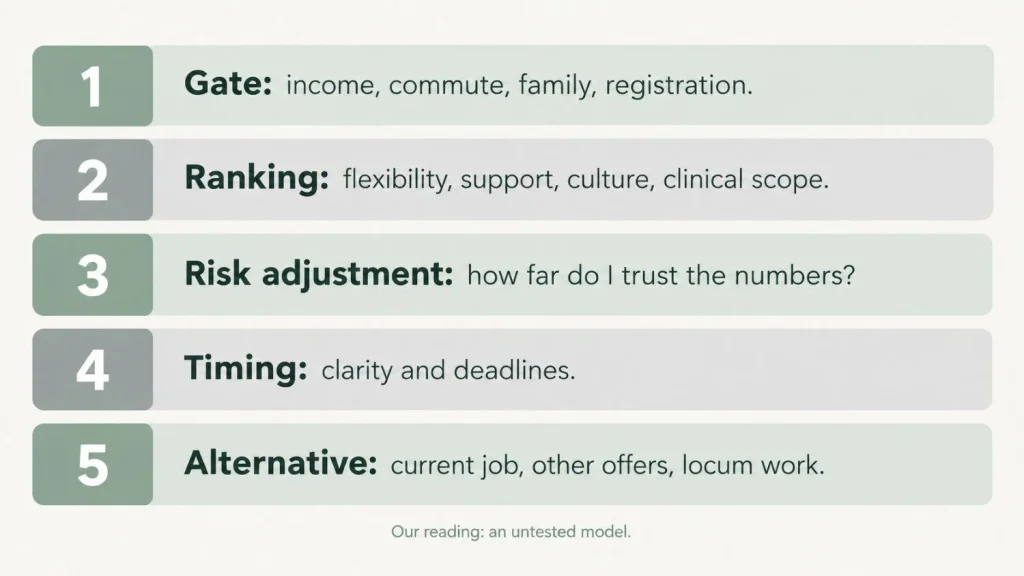
Owners tend to underrate the fifth filter. In the 2021 Healthed survey, reported by Medical Republic, 70% of GPs had not changed practice in the previous five years. In AusDoc’s survey, about half had held their current job for five years or more.
Both are samples of working GPs, not of people who turned down offers, but the pattern fits what recruiters describe: many declines are a candidate choosing to stay, so you are competing with a job they already know.
How easily a candidate can say no also depends on the market. Pracxcel’s own GP guide notes that a national shortage means good GPs usually have several offers. DoctorConnect, a recruiter, says more candidates are now available for some outer-metro and regional roles in 2026. Both can be true in different places. Check how many applicants you actually receive per vacancy and how your ad compares with live local ads before assuming either.
How do you tell a fixable decline from one you should let go?
Before deciding what to change, decide what kind of decline you had.
| Type | What it looks like | The test | What to do |
|---|---|---|---|
| Fixable | Terms the candidate couldn’t compare, slow replies, vague claims, nothing they could check | Would a clearer, faster or more specific version of the same offer have changed the answer? | Fix the offer and the process |
| Structural | Commute, family, location or registration limits | Would nothing within your control have changed it? | Don’t chase. Keep the door open |
| Correct | The candidate found something real: unstable rosters, unwritten promises, unverifiable turnover | Would you advise a friend to take this role on these terms? | Fix the practice, not the pitch |
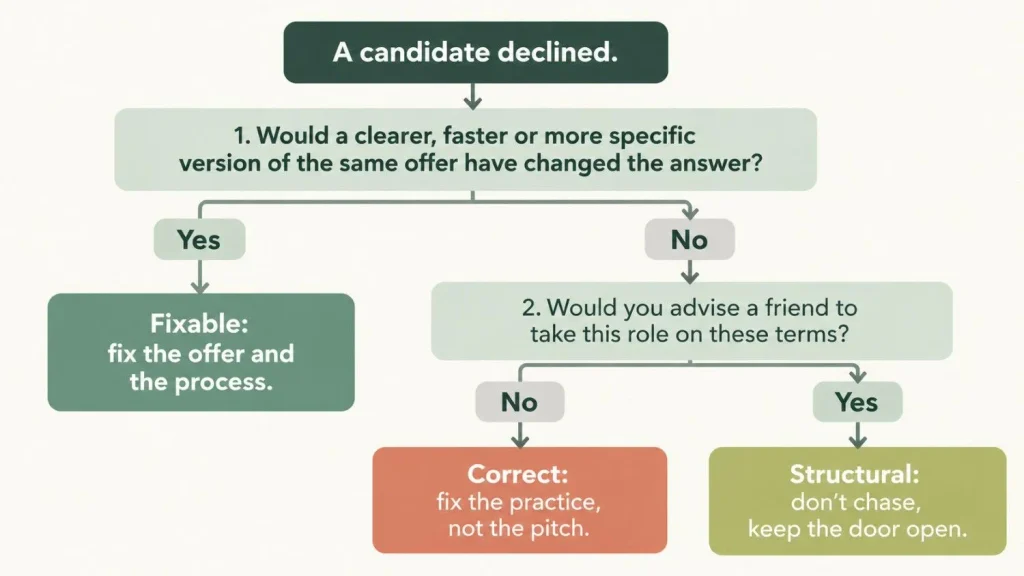
Stage narrows the cause. These are starting points, not findings.
| Stage | Common causes | First check |
|---|---|---|
| Went quiet before interview | Thin or hard-to-find ad, long or slow application | Read your ad as a stranger and time your replies. Silence at this stage usually traces back to what candidates find before they apply |
| Declined at offer | Terms not comparable, another offer, timing | Run the computability test below and check deadlines |
| Withdrew after accepting | A later offer, new information, registration or family changes | Look at the gap between acceptance and start, and who stayed in contact |
Two illustrative cases
These are invented to show the method. They are not real practices.
Case 1: fixable. A vocationally registered GP declines your offer of 65% of billings. In the debrief she says the percentage was fine, but she couldn’t tell how many patients she would see an hour or whether she would inherit a list, and another practice quoted 70% with an established list. Triage: fixable, at the offer stage. The fix is information: state typical patients per hour, whether the list is inherited and what a doctor at the practice typically bills. A higher percentage might not have changed her answer.
Case 2: structural. A GP does well at interview, then declines because her partner’s work would mean a 90-minute commute each way. Triage: structural. No change to the offer would have fixed it. Thank her, ask to stay in touch and don’t spend a concession on it. If she would consider two days a week or a locum trial, that is a different offer, not a better one.
The five-question debrief
Ask within a week, by phone, and preferably from someone other than the owner. Candidates are politer to the person who made the offer, so expect softened answers and listen for patterns.
- What decided it?
- What nearly changed your mind?
- What was unclear or surprised you?
- What were you comparing us with?
- What one change would have made it a yes?
Log the stage, the cause and the type. A practice that hires two or three doctors a year can’t learn much from one decline, and no standard threshold exists for a pattern. As a working rule, treat the same cause appearing in two or three declines as a reason to investigate, not as proof.
Why a higher percentage doesn’t always win: make the offer computable
A percentage means nothing without a base
HealthcareLink, a job board, says almost every GP ad in Australia quotes pay as a percentage of billings, typically 60% to 75%, not a salary. A doctor’s income is that share of what they bill. What they bill depends on patients per hour, average billing per patient, hours worked and the billing model: bulk billing, mixed or private. A higher percentage of a thin base can pay less than a lower percentage of a full one.
A worked comparison
HealthcareLink illustrates this with two offers. Offer A is a mixed-billing practice at 65%, with a $150 an hour guarantee for three months and about six patients an hour. Offer B is a fully bulk-billing practice at 70%, with no guarantee and about five patients an hour. It does not give average billing per patient, so the table indexes that missing input instead of inventing dollar figures.
| Offer A | Offer B | |
|---|---|---|
| Share of billings | 65% | 70% |
| Patients per hour | 6 | 5 |
| Average billing per patient (index) | 100 | 111.4 needed to match |
| Doctor’s income per hour (index) | 390 | 390 |
Model: Offer B only matches Offer A if its average billing per patient is about 11.4% higher (6 × 0.65 = 3.9, against 5 × 0.70 = 3.5, and 3.9 ÷ 3.5 = 1.114). This ignores A’s guarantee, which lifts A’s early months further.
HealthcareLink also reports that the Bulk Billing Practice Incentive Program (BBPIP), introduced in November 2025, adds a 12.5% loading on the Medicare benefit for practices that bulk bill every eligible service, split between the GP and the practice. The loading changes the billing base for bulk-billing practices, so ask each practice what it is worth per consult and how it is split.
Throughput matters beyond income. Six patients an hour and five are different working days, and our reading is that a candidate weighs the quality and burnout cost of volume as well as the pay.
A Healius recruiter quoted by Medical Republic said doctors often join or leave over nursing support and the chance to focus on medicine, not admin, and sometimes to try mixed billing instead of bulk-billed walk-ins. Say what support comes with the role: nursing, on-site pathology, software, and appointment length.
The computability test
Replace “is my offer clear?” with a harder question: could the candidate turn it into a weekly income figure? For each item, mark it given, estimable or unknown:
- share of billings and billing model
- typical patients per hour and appointment length
- typical weekly billings for a doctor at the practice
- guarantee amount, length and what happens when it ends
- patient list: inherited or built from scratch
- hours and sessions
- what the percentage covers and what the doctor funds
Our reading: a candidate who can’t compute the offer will assume the lower of the plausible figures. Every “unknown” is a place where that happens.
Compare like with like: contractor or salaried?
A percentage offer usually means the doctor works as a contractor, not an employee. Contractor GPs generally do not receive employee entitlements such as paid leave, and how superannuation, indemnity and payroll tax apply varies, so get accounting advice on your own arrangement. A candidate weighing your 70% against a salaried hospital role is comparing different things, and will either do that sum or assume the worst.
This seems to matter. Among the GPs AusDoc surveyed, 47% wanted paid training and 38% extra paid leave in their next job, against 35% who wanted a higher salary. Say plainly what your percentage covers and what the doctor funds.
Say why the role exists
A recruiter quoted by Medical Republic notes that candidates want to picture the situation they would be starting in: a retiring GP’s list, a backfill or growth. In AusDoc’s earlier survey of more than 500 GPs, one GP said an advertised inherited list is appealing, and another that a better percentage means little without patients. One sentence on why the role exists and what list comes with it removes a guess.
When does a guarantee beat a higher share?
A guarantee reduces income variance in the first months, when a doctor new to an area is building a list. DoctorConnect gives a common example of about $150 an hour for 38 hours a week for three months, which is $5,700 a week or about $68,400 over 12 weeks. That is the ceiling on your exposure if billings were zero. Your real cost is only the gap.
Model: weekly top-up = guaranteed hourly rate × hours, minus the doctor’s share of billings, never below zero. At a 60% share and $5,000 in weekly billings, the doctor’s share is $3,000 against a $5,700 guarantee, so you top up $2,700. At $9,250 in weekly billings the share is $5,550 and the top-up is about $150.
Our reading: a guarantee costs you only the gap while the list builds, while a higher permanent share costs you on every consult for as long as the doctor stays. For a candidate new to the area, the guarantee often addresses the actual worry more directly. For an established GP with a full book elsewhere, it may matter much less.
Are sign-on bonuses still common in 2026?
DoctorConnect reports that payments of $15,000 to $20,000 were fairly common for some regional roles in 2023 and 2024, fell to $5,000 to $10,000 by 2025, and that many practices now offer none. That is one recruiter’s view of its own market, and its post is aimed at overseas-trained GPs moving to Australia, so it may not describe the wider market. If budget is tight, accommodation on arrival, relocation help or a guarantee tend to meet a real worry more directly than a lump sum.
Flexibility is part of the offer
Flexibility was a deciding factor for 56% of AusDoc’s GPs, and more often for women. Part-time sessions, job share and school-hour rosters each cost something in room use, continuity or team load, so advertise only what you can sustain. How to state pay, support and conditions in the ad itself is covered in attracting GPs with digital marketing.
Is it worth matching a competing offer? What a concession really costs
In this model, the cost of a concession against a vacancy does not depend on what the doctor bills. Billings cancel out.
Model. Assume your overheads are fixed and the room would otherwise sit empty.
- A concession costs the extra share points times the doctor’s weekly billings, every week the doctor stays.
- An empty room costs you the share you would have kept, times the same billings, each week.
- Over one year, the concession breaks even against vacancy weeks saved when weeks saved = 52 × extra points ÷ the percentage you keep.
At a 65% share to the doctor you keep 35%. A 5-point concession then needs about 7.4 vacancy weeks saved in year one. If the doctor stays two years, about 15 weeks. If three, about 22. To estimate weeks saved, use how long your last two vacancies actually took to fill.
As an optional illustration only, at weekly billings of $9,250 (an assumption within the $9,000 to $9,500 DoctorConnect reports for well-run practices in shortage areas) the concession costs about $462 a week, or $24,050 a year, and an empty week costs you about $3,240. Use your own figures.A concession is not the only lever, and its cost has a different shape from the others.
A concession is not the only lever, and its cost has a different shape from the others.
| Lever | Cost shape | Best when |
|---|---|---|
| Higher share | Recurring, scales with billings, lasts as long as the doctor stays | Pay was genuinely the gate and the doctor’s volume is proven |
| Guarantee | One-off, capped at the gap, then ends | The worry is ramp-up income |
| Flexibility (sessions, job share) | Room use, patient continuity, team load | The candidate cited flexibility or family |
| Paid training, mentoring | Time and fees | The candidate is early-career or changing scope |
| Relocation help, accommodation | One-off | The candidate is moving from elsewhere |
This table is our reading, not a tested ranking. Three cautions apply.
- Margin ceiling. William Buck, an accounting firm, warned in 2021 that paying a doctor more than about 70% would in most cases leave the practice with no gain or a net loss at benchmark expense levels. That is dated and depends on your costs, so check your own.
- Parity. Consider whether existing doctors would expect the same share.
- What the model leaves out: patient access, team load, what the doctor really bills, and tax.
How fast do you need to move? The decision clock
A candidate may be running several processes, and they will not match your timeline. In WA’s public hospital system, MedCareersWA says offers usually expire after four business days. Hospital and registrar offers run on faster, more rigid clocks than most practice hiring.
A 2017 Tasmanian parliamentary reply described late withdrawal of accepted registrar offers as common around Australia, though that source is dated. A practice process that takes weeks looks slow beside them.
What to do:
- Ask when they expect to hear from other employers.
- Publish your timeline: interview, decision, written offer, start date.
- Name one contact and reply within a working day.
- Put the offer in writing: pay structure, billing model, guarantee, sessions, conditions and start date.
- Consider a conditional offer, for example subject to references or registration. HealthcareLink suggests this reduces uncertainty for candidates.
- Stay in contact between acceptance and start.
Registration and credentialing lag often sit between a yes and a start date. That gap is a risk for you and a worry for them, so explain it early.
A yes is weaker than it feels
This is general information, not legal advice. In Australia an accepted offer can form a binding agreement (an employment contract for an employee, a services agreement for a contractor) before the first day. Legal-information sites such as Lawpath say a candidate can generally still withdraw after accepting, while an employer who withdraws risks a breach claim.
A verbal or signed yes therefore protects you less than a relationship does. If the offer is conditional, say so in writing before acceptance, and take legal advice for your own situation.
Which declines can’t you fix?
Some declines are about things your offer can’t change. Recognise them early and stop spending effort.
| Constraint | What it means | What you can do |
|---|---|---|
| Commute | The top reason in Healthed for leaving a practice (25%) and for choosing one (32%) | State the real travel time, parking and transport. Consider a compressed week |
| Family and partner | Schools, a partner’s work, distance from relatives | Give honest local information. Offer a visit with family |
| Location classification and eligibility | Whether a role is in a Distribution Priority Area (DPA) or sits on the Modified Monash scale (MM1 to MM7), and whether a doctor is subject to section 19AB of the Health Insurance Act (a Medicare restriction that can tie some overseas-trained doctors to certain locations), can decide whether they can take the role at all | Be specific about what the role qualifies for. Never promise registration, visa or provider-number outcomes. Point candidates to Department of Health and Ahpra pages |
| Overseas-trained pathways (such as the PEP Specialist or expedited pathways) | Some involve supervised practice and location conditions, so eligible roles and start dates differ | Write down your supervision and onboarding plan before marketing the role |
| Registration and provider-number timing | A gap between yes and start | Explain it at the start |
| A good current job | The main competitor, as above | Stay in touch and keep a talent list, with consent |
Two options help when the barrier is uncertainty rather than a fixed limit. A locum-to-permanent arrangement lets a candidate test the location. Any trial involving real work should be paid, because unpaid trial shifts can be unlawful in Australia. Check Fair Work Ombudsman guidance.
When a decline is structural, close politely, ask to stay in touch and move on.
When is the decline right?
Sometimes the candidate saw something real, and a decline is the cheapest early warning you will get. Audit your practice as if you were the candidate:
- Is the roster stable, and who covers leave?
- What patient volume and appointment length are expected?
- Why did the last doctor leave, and could a candidate speak to them?
- Do the contract terms match the ad, including notice, deductions and any restriction on where they can work later?
- Are verbal promises written down?
- Is the practice financially stable, and are there plans to sell?
The last two come from a US employment lawyer quoted by Medscape, who advises doctors to ask exactly these questions. The advice is American, but Australian candidates have the same reasons to ask. If you would not take the role yourself on these terms, no amount of better marketing will fix it.
What should you check before the offer goes out?
Many declines that surface at the offer stage were shaped earlier, by what a candidate could find. This is where marketing is legitimately relevant, and three checks cover most of it.
- Job-board filters. AusDoc’s job search lets candidates filter by billing percentage band, sign-on bonus, relocation assistance, clinic type and DPA status. An ad that omits the billing percentage or model may be filtered out of those searches, and one that appears gives the reader less to go on. This is untested.
- One fact sheet. Keep a single document with the facts candidates compare, and copy from it into every ad, page and profile so no two sources disagree. A careers page should let a candidate on a phone find the role, pay, location, team and how to apply within a minute, and a fast, mobile-friendly healthcare website makes that easy to maintain.
- Patient reviews stay off recruitment pages. Ahpra’s advertising rules restrict testimonials about clinical aspects of a service, and careers pages often sit on patient-facing sites, so run recruitment posts through an AHPRA advertising checklist before they go live.
To audit everything a candidate can find about you, run the 30-minute Candidate Check.
What the evidence can and can’t tell you
| Source | What it measured | Sample | Limit |
|---|---|---|---|
| AusDoc JOBS survey (2024) | Factors in accepting a role | 707 GPs | Self-reported. About accepting, not declining |
| Healthed, via Medical Republic (2021) | Why GPs left a practice, what attracted them | About 850 GPs, mostly capital cities, mostly over 50 | Older, settled sample |
| Adfire Health, via Becker’s | Reasons physicians reject employers | 112 US physicians, 30 specialties | US, small, method not published, date to confirm |
| AAPPR, via the AMA (April 2026) | Physician offer acceptance and time to fill | US in-house recruiters | US. Acceptance rates, not reasons |
| William Buck (2021) | Owner poll and margin warning | Over 100 owners | Dated. Owner’s view |
| DoctorConnect and HealthcareLink (2026) | Recruiter views on bonuses, guarantees, billing | Not stated | Recruiter commentary, not research |
The most useful benchmark we found is American. US in-house recruiters, reported by the AMA in April 2026, put physician offer acceptance at about 70% and typical time to fill at about 121 days. It isn’t transferable to Australian practices, where billing and employment structures differ.
No source gives an Australian decline rate. None interviewed doctors who had declined. The best Australian surveys predate the November 2025 bulk-billing incentive. The most reliable data you can get is your own, which is why the debrief and the log matter.
Where does outside help fit?
You can do most of this yourself: the debrief, the computability test, the concession maths and faster replies. A specialist healthcare recruiter helps with hard-to-fill roles and candidate networks, usually for a placement fee. Job boards reach active candidates but test your presentation more than they build it.
A marketing partner is relevant when the debrief points to findability, a careers page that doesn’t answer a candidate’s basic questions, or facts that differ across your ad, website and Google profile.
Pracxcel works on healthcare websites, local visibility, ads and social media. We can’t fix an offer, a commute or a roster, and if your debrief points there, fix that first. If you’d like a second opinion on what your declines are telling you, talk to the Pracxcel team.


